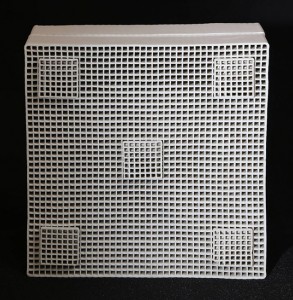
Segmented Honeycomb for RTOs
Drop-in replacement with enhanced reliability and cost advantage
Lantec's Segmented Honeycomb delivers the same heat transfer performance as conventional honeycomb monolith while solving two persistent problems: thermal shock failure from temperature cycling, and the cost premium of traditional monolith extrusion. The segmented architecture distributes thermal stress across independent pieces and enables more economical manufacturing — a combination that reduces both purchase cost and lifetime maintenance.
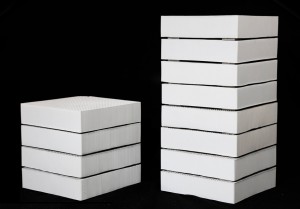
Same Performance, Better Economics
Segmented Honeycomb provides identical heat transfer geometry to conventional honeycomb monolith: same cell counts (25, 40, 43, 50, 60, etc.), same pressure drop characteristics, same thermal efficiency at equivalent bed depth. The difference is manufacturing architecture and what it enables.
Traditional monolith extrusion produces large continuous blocks. Segmented Honeycomb produces smaller independent pieces that stack into equivalent beds. The thermal performance is identical. The manufacturing economics are fundamentally different.
Thermal Shock Protection
Conventional monolith concentrates thermal stress across single large blocks. When temperature gradients exceed ceramic's tolerance, cracks propagate through the entire piece.
Segmented architecture distributes thermal zones across independent segments. Each segment handles its own thermal gradient. A segment that cracks doesn't compromise adjacent segments. The bed continues operating while individual pieces are replaced during scheduled maintenance rather than emergency shutdown.
Plugging Resistance
Long monolith channels accumulate particulates progressively. Segmented design creates natural mixing zones at segment interfaces where turbulence disrupts particle accumulation pathways. The shorter individual flow paths reduce the opportunity for channel plugging.
Cost Advantage
Segmented manufacturing is more economical than traditional monolith extrusion. This advantage has become more pronounced as European honeycomb costs have increased approximately 30% due to tariff effects. Segmented Honeycomb offers equivalent performance at meaningfully lower delivered cost for North American installations.
Key Benefits
-
Equivalent heat transfer performance — Same cell densities, pressure drop, and thermal efficiency as conventional honeycomb
-
Enhanced thermal shock protection — Distributed thermal zones prevent crack propagation across bed sections
-
Improved plugging resistance — Segment interfaces create turbulent mixing zones that disrupt particle accumulation
-
Significant cost advantage — Manufacturing innovation and favorable trade positioning reduce delivered cost
-
Standard configurations — Available in all conventional cell densities (25, 30, 40, 43, 50, 60, etc.)
Performance Data & Literature
Case Studies
Technical Specifications
Segmented Honeycomb Physical Properties — British Units
| Property | SHC-25 | SHC-40 | SHC-43 | SHC-50 |
|---|---|---|---|---|
| Cell Count | 25 × 25 | 40 × 40 | 43 × 43 | 50 × 50 |
| Module Size (in) | 5.9 × 5.9 × 3.0 or 5.9 × 5.9 × 5.9 | 5.9 × 5.9 × 3.0 or 5.9 × 5.9 × 5.9 | 5.9 × 5.9 × 3.0 or 5.9 × 5.9 × 5.9 | 5.9 × 5.9 × 3.0 or 5.9 × 5.9 × 5.9 |
| Heat Capacity (BTU/ft³·°F) | 10.0 | 10.9 | 10.9 | 11.3 |
| Weight (lb/ft³) | 41 | 44 | 44 | 46 |
| Void Fraction (%) | 72 | 70 | 70 | 68 |
| Maximum Working Temp | 2,025°F | 2,025°F | 2,025°F | 2,025°F |
Segmented Honeycomb Physical Properties — Metric Units
| Property | SHC-25 | SHC-40 | SHC-43 | SHC-50 |
|---|---|---|---|---|
| Cell Count | 25 × 25 | 40 × 40 | 43 × 43 | 50 × 50 |
| Module Size (mm) | 150 × 150 × 75 or 150 × 150 × 150 | 150 × 150 × 75 or 150 × 150 × 150 | 150 × 150 × 75 or 150 × 150 × 150 | 150 × 150 × 75 or 150 × 150 × 150 |
| Heat Capacity (kJ/m³·°K) | 674 | 728 | 728 | 760 |
| Weight (kg/m³) | 660 | 710 | 710 | 740 |
| Void Fraction (%) | 72 | 70 | 70 | 68 |
| Maximum Working Temp | 1110°C | 1110°C | 1110°C | 1110°C |
Material Properties
| Property | Value |
|---|---|
| Specific Gravity | 2.2–2.5 |
| Water Absorption (ASTM C373) | ≤ 3.0% |