
Q-PAC® Tower Packing
More Transfer. Less Resistance. One Packing.
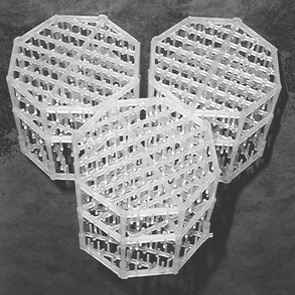
Q-PAC's drip point structure disperses liquid streams into suspended droplets — every surface contacting the gas phase directly. The same open geometry leaves no broad surfaces to block airflow, enabling operating velocities well above conventional packings. Engineers design towers 35–40% smaller around Q-PAC, with lower capital costs and fan energy savings that continue for the life of the installation.
How It Works
Conventional packings spread liquid across plastic surfaces to promote gas-liquid contact. More surface area means more plastic, which means more resistance to airflow. Efficiency and capacity trade against each other.
Q-PAC's drip point structure disperses liquid into suspended droplets instead. Every surface of every droplet contacts the gas phase directly. The same open geometry that creates those droplets leaves no broad surfaces to impede airflow — efficiency and capacity improve together from the same mechanism. At equivalent gas velocities, Q-PAC operates well below its flooding point where conventional packings are already approaching theirs. (Flooding Curve Data)
System Design Advantages
When Q-PAC's higher operating velocity allows a smaller tower diameter, every downstream component scales with it. A smaller tower requires a smaller recirculation pump, a smaller mist eliminator, and less total packing volume to achieve the same treatment objective. The effect compounds across the system:
| Saddles / Pall Rings | 3.5" Tri-Packs | Q-PAC | |
|---|---|---|---|
| Design gas velocity | 290 ft/min | 442 ft/min | 637 ft/min |
| Tower diameter | 15 ft | 12 ft | 10 ft |
| Recirculation rate | 1,060 gpm | 678 gpm | 471 gpm |
| Mist eliminator | 15' dia × 6" | 12' dia × 6" | 10' dia × 6" |
| Total packing volume | 1,539 ft³ | 1,130 ft³ | 785 ft³ |
Standard sizing scenario: 50,000 cfm H₂S odor control scrubber. (Full Design Example)
Smaller-diameter columns also eliminate special transport permitting for oversized vessels and field erection costs that don't appear in a per-cubic-foot packing comparison but matter substantially on total installed cost. Documented across installations: 35–40% reductions in total tower cost. (Case History 53, Case History 54)
Operating Performance
Q-PAC's velocity headroom — the same headroom that enables smaller towers in new construction — becomes capacity reserve in existing systems. Scrubbers operating below Q-PAC's flooding limit can handle increased throughput without media replacement or tower modification, at a fraction of the cost of additional equipment.
Q-PAC's open bar-and-rod geometry is also inherently self-cleaning. Uniform spacing eliminates the dry spots and stagnant zones where mineral scale and biological growth accumulate in denser packings, reducing maintenance downtime and extending media service life.
For older towers on conventional media, retrofitting with Q-PAC recovers capacity and efficiency at substantially lower cost than new construction. (Case History 31)
Applications
Q-PAC is the specified packing for wet scrubbing and air stripping across municipal, industrial, and large-scale environmental applications: acid gas and odor control, VOC and HAP removal, groundwater air stripping, biological treatment, and high-capacity seawater flue gas desulfurization. Q-PAC is the preferred packing for seawater FGD systems at scales up to 8 million Nm³/h. (Seawater FGD Application Brief)
Design Your System with Lantec
Lantec's engineers will size your packed bed at no charge — and back the design with a performance warranty. Contact Lantec's technical department.
Key Benefits
-
96.3% void fraction — Highest of any commercial packing, enabling dramatically lower pressure drop
-
11,000 drip points per cubic foot — Three-layer construction creates surface density impossible in single-piece molding
-
30–50% higher capacity — Operates at twice conventional packing velocities (600+ ft/min vs. 350 ft/min)
-
System-level capital savings — Smaller tower diameter means proportionally smaller pumps, blowers, and mist eliminators; 35–40% tower cost reductions documented
-
Self-cleaning geometry — Uniform bar-and-rod spacing eliminates dry spots and resists fouling
Performance Data & Literature
- Q-PAC Brochure (PDF)
- 16-Page Q-PAC Data (PDF)
- Pressure Drop Curves — Metric (PDF)
- Pressure Drop Comparisons — Metric (PDF)
- DataA: Designing with Q-PAC (PDF)
- DataB: Acid Gas Scrubbing (PDF)
- DataC: Flooding Curve (PDF)
- DataD: Pressure Drop (PDF)
- DataE: Liquid Holdup (PDF)
- DataF: Packing Comparisons (PDF)
- DataH: HTU Curves (PDF)
- Technical Support Paper- Odor Control Scrubber Design (PDF)
- Technical Support Paper- SO₂ Scrubber Design Notes (PDF)
Case Histories
- $8,300/Year Power Savings at Pittsfield Municipal Incinerator
- Poultry Processing Waste Scrubbers Installed Without Fan Modification
- Using Reclaimed Water in Scrubbers With Fouling-Resistant Q-PAC
- Camden Biosolids Scrubber: Documented capital savings, non-detectable outlet emissions
- MEK Air Stripper: 35–40% Capital Reduction
- Perth Two-Stage H₂S System
- Rendering Plant: 34% Capacity Increase
- Kraft Mill: $80K/Year Power Savings
- Cheese Processing Wastewater
- Environmental Protection: Greenhouse Gas Impact
- Q-PAC for Biotowers (PDF)
- Seawater FGD Application Brief (PDF)
Technical Specifications
Q-PAC® Physical Properties
| Property | British Units | Metric Units |
|---|---|---|
| Dimensions | 3.25" × 3.75" | 83 mm × 95 mm |
| Void Fraction | 96.3% | 96.3% |
| Geometric Surface Area | 30 ft²/ft³ | 98 m²/m³ |
| Weight (polypropylene) | 2.1 lb/ft³ | 34 kg/m³ |
| Weight (PVDF) | 4.1 lb/ft³ | 66 kg/m³ |
| Piece Count | 33/ft³ | 1,165/m³ |
| Packing Factor | 7/ft | 23/m |
| Drip Points | 11,000/ft³ | 388,000/m³ |
Materials
Q-PAC is available in multiple thermoplastics:
- Polypropylene — Standard material for most applications
- Glass-filled PP (GFPP) — High-temperature applications
- Polyethylene — Alternative where PP chemical compatibility is required
- PVDF/Kynar — Aggressive chemical service, elevated temperatures
Contact Lantec's technical department at 617-302-3269 for material recommendations.