
LANPAC-XL® High Efficiency Tower Packing
Maximum drip point density for air strippers and degasifiers
LANPAC-XL doubles Q-PAC's drip point density — 22,000 points per cubic foot versus 11,000 — by adding a fourth stacked layer to the proven rod-grid architecture. The result is higher mass transfer efficiency per unit bed depth, enabling shorter towers or higher removal rates in existing equipment. The tradeoff is slightly higher pressure drop, making LANPAC-XL the right choice when tower footprint is constrained and the system can accommodate additional head.
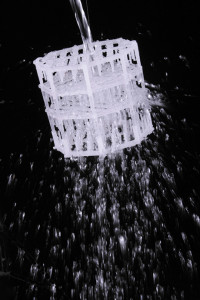
Four-Layer Construction
LANPAC-XL and Q-PAC share the same fundamental architecture: stacked rod-grid layers that create drip points for breaking liquid streams into fine droplets. The difference is depth. Q-PAC uses three layers; LANPAC-XL uses four. Each additional layer contributes its rod population to the total, compounding the drip point density that drives mass transfer performance.
This construction principle — impossible in single-piece injection molding — is what separates the LANPAC-XL/Q-PAC family from conventional random packings. The drip points fill three-dimensional space with droplets, presenting their entire surface area to the gas phase rather than spreading liquid across two-dimensional plastic surfaces.
The Right Tradeoff
Higher drip point density means more gas-liquid contact per cubic foot, but also somewhat higher resistance to gas flow. LANPAC-XL operates at the high-efficiency end of the pressure drop/mass transfer curve — shorter beds, more work per unit depth, higher total pressure drop than Q-PAC at equivalent bed volume.
This makes LANPAC-XL the natural choice for:
- Air strippers where tower height drives project cost
- Degasifiers targeting aggressive dissolved gas specifications
- Biological treatment systems requiring maximum surface area for biofilm development
- Any application where the blower can handle additional head and bed depth is the constraint
NSF Certification for Potable Water
For direct contact with drinking water in treatment systems with a minimum flow rate of 1.6 gallons per minute per square foot (96 gallons/hour/ft²)

Materials
LANPAC-XL is available in polypropylene as standard. Contact Lantec's technical department for alternative thermoplastics in elevated temperature or aggressive chemical service.
Design Your System with Lantec
Lantec's engineers will size your packed bed at no charge — and back the design with a performance warranty. Contact Lantec's technical department.
Key Benefits
-
22,000 drip points per cubic foot — Twice Q-PAC's drip point density for maximum mass transfer efficiency
-
Four-layer stacked construction — Patented architecture impossible in single-piece injection molding
-
Shorter packed beds — Higher efficiency per unit depth reduces tower height requirements
-
NSF certified for potable water — Approved for direct contact with drinking water
Performance Data & Literature
Case Histories
Technical Specifications
LANPAC-XL® Physical Properties — British Units
| Property | Value |
|---|---|
| Dimensions | 3.25" × 3.75" |
| Effective Surface Area | 74 ft²/ft³ |
| Void Fraction | 95% |
| Weight (polypropylene) | 2.8 lb/ft³ |
| Piece Count | 33/ft³ |
| Drip Points | 22,000/ft³ |
| Packing Factor | 10/ft |
| NSF Certified | Yes |
LANPAC-XL® Physical Properties — Metric Units
| Property | Value |
|---|---|
| Dimensions | 83 mm × 95 mm |
| Effective Surface Area | 242 m²/m³ |
| Void Fraction | 95% |
| Weight (polypropylene) | 45 kg/m³ |
| Piece Count | 1,165/m³ |
| Drip Points | 776,600/m³ |
| Packing Factor | 33/m |
| NSF Certified | Yes |