
MLM® Multi-Layer Media
The structured heat recovery standard for RTO retrofits
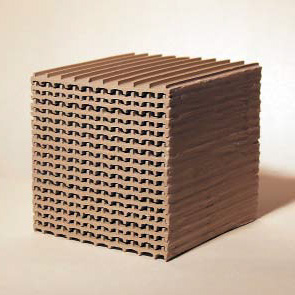
MLM's layered construction delivers high heat capacity with substantially lower airflow resistance than ceramic saddles — without the thermal fracture that limits monolith service life. Bed depths reduce by 50% or more, fuel and power costs fall, and documented retrofits pay back within a year from operating savings alone.
Where Conventional Ceramic Fails
Ceramic saddles nest and compress under service load, restricting airflow and accumulating particulates. Monolith honeycomb cracks under thermal cycling due to temperature gradients across full-depth blocks. MLM's layered construction and interleaved channels solve both failure modes, and Lantec-guided MLM field installations are not subject to the structural degradation or thermal fracture that can occur in saddle and monolith installations. Four configurations — MLM-125 through MLM-200 — span the heat capacity/pressure drop curve (specifications below.)
Reduce Operating Costs
Replacing ceramic saddles with MLM cuts both fan power consumption and fuel use in a single retrofit. Lower pressure drop means less horsepower to move the same air volume; higher heat capacity per cubic foot improves thermal efficiency, reducing natural gas consumption to maintain combustion temperature. Documented installations show annual savings of $78,000–$100,000 or more; at that scale the media investment can pay back in under a year. (Case Study 42, Case Study 33)
Boost Capacity Without a Second RTO
MLM's low pressure drop enables higher gas velocities — 400 scfm/ft² or more — with sustained heat recovery. Throughput gains of 40% or more have been documented without adding equipment; what would otherwise require a second RTO is accomplished by replacing media and upgrading the fan. In applications where random media became airborne at design velocity, MLM has succeeded where multiple conventional alternatives could not. (Case Study 29, Case Study 50, Pollution Engineering: Fitchburg)
Handle Dirty Air Streams
MLM's parallel plate geometry and interleaved channels together eliminate the plugging modes that force frequent maintenance with conventional media. Ceramic saddles trap particulates between pieces; straight honeycomb channels accumulate them end-to-end. MLM passes both. Installations that required washouts every two weeks with saddles now operate for months between cleanings, with pressure drop fully restored after each wash. (Case Study 33, Case Study 42)
Design Your System with Lantec
Lantec's engineers will size your MLM installation at no charge — selecting the right configuration and bed depth for your operating conditions — and back it with a performance warranty.
Request Free DesignKey Benefits
-
50%+ bed depth reduction — MLM-200 achieves equivalent thermal efficiency in half the bed depth of saddles
-
High heat capacity with low airflow resistance — MLM's layered construction delivers the thermal efficiency of a deep ceramic bed at half the depth, without the pressure drop penalty of conventional random packing
-
Plugging resistance — Parallel channels pass particulates rather than accumulating them
-
Capacity expansion possible — Higher velocities achievable without proportional pressure drop increase
-
Rapid retrofit payback — $80,000–$100,000+ annual savings documented in multiple installations
Performance Data & Literature
Case Histories
- RTO Capacity Increased 50% with Improved Thermal Efficiency
- Emergency Maintenance Events Eliminated at Hatfield WWTP
- Hatfield WWTP: Biosolids RTO Retrofit — Pollution Engineering (1999)
- Biosolids RTO Retrofit Yields $78,000/Year Savings
- Autothermal RTO Retrofit with $100,000+ Annual Savings
- Pollution Engineering: Fitchburg $1.14M Revenue Case
- MLM vs. Conventional RTO Heat Recovery Media
Technical Specifications
MLM® Physical Properties — British Units
| Property | MLM-125 | MLM-160 | MLM-180 | MLM-200 |
|---|---|---|---|---|
| Standard Module Size | 12" × 12" × 4" | 12" × 12" × 4" | 12" × 12" × 4" | 12" × 12" × 4" |
| Heat Capacity (BTU/ft³·°F) | 10 | 12 | 14 | 16 |
| Weight (lb/ft³) | 40 | 52 | 59 | 66 |
| Void Fraction (%) | 72 | 64 | 59 | 54 |
| Maximum Working Temp | 2,160°F | 2,160°F | 2,160°F | 2,160°F |
| Cold Crushing Strength (lb/ft²) | 8,600 | 11,000 | 12,500 | 15,000 |
MLM® Physical Properties — Metric Units
| Property | MLM-125 | MLM-160 | MLM-180 | MLM-200 |
|---|---|---|---|---|
| Standard Module Size | 305 × 305 × 102 mm | 305 × 305 × 102 mm | 305 × 305 × 102 mm | 305 × 305 × 102 mm |
| Heat Capacity (kJ/m³·°C) | 670 | 810 | 940 | 1070 |
| Weight (kg/m³) | 640 | 840 | 950 | 1060 |
| Void Fraction (%) | 72 | 64 | 59 | 54 |
| Maximum Working Temp | 1180°C | 1180°C | 1180°C | 1180°C |
| Cold Crushing Strength (kPa) | 412 | 527 | 599 | 718 |
Material Properties (All MLM Configurations)
| Property | Value |
|---|---|
| Specific Gravity | 2.25–2.35 |
| Water Absorption (ASTM C373) | < 0.5% |
| Acid Resistance Wt. Loss (ASTM C279) | < 4% |