
Biosolids Incinerator Operator Retrofits RTO to Improve Air Flow
by Ann Hasbach, Contributing Editor
Reprinted from Pollution Engineering, November 1999, pp. 55–56
The Municipal Wastewater Treatment Plant in Hatfield, PA uses an 8,000 standard-cubic-feet-per-minute (scfm) regenerative thermal oxidizer (RTO) to control volatile organic compound emissions from its multiple-hearth sludge incinerator.
Since its 1994 startup, the RTO had consistently met all regulatory emissions limits with a significant margin of safety. However, after approximately a year of operation, the pressure drop across the ceramic saddles in the heat-recovery canisters had increased to a level that compromised the induced-draft (ID) fan capacity. Washing the saddles initially restored the pressure profile, but the required frequency of washing increased with operation.
The washing procedure required an 18-hour shutdown of all processing operations. Heat recovery diminished over time, causing fuel gas costs to skyrocket.
Trial Installation
In consultation with Stan Chilson of CET Engineering Services in Harrisburg, PA, plant operators experimented with ceramic multi-layer media (MLM) supplied by Lantec Products of Agoura Hills, CA. These media use parallel-flow channels to provide high heat capacity without high pressure drop. Hatfield decided initially to try the media in only one of the three heat-recovery canisters. Eight feet of 1-inch saddles were replaced with 4 feet of MLM.
The media were changed out. The pressure drop across the two remaining cans packed with saddles was initially 5.1 inches of water column (W.C.) It crept up to between 8 inches and 9 inches during the first nine days of operation.
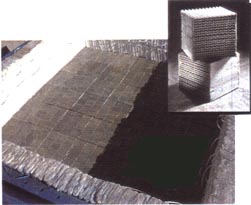
The canister repacked with MLM showed an initial pressure drop of 1.5 inches W.C., which did not increase measurably over the same nine-day period. The average stack temperature was approximately 50°F lower when exhaust gas passed through the repacked canister, indicating improved heat recovery. However, the two canisters packed with saddles had to be washed out in two-week intervals to keep the RTO pressure drop from exceeding fan capacity.
Full Conversion
The other two canisters were repacked with MLM in late August. The pressure drop across each canister now measures 1.5 to 2.5 inches W.C., resulting in a 35–40% reduction in fan power consumption.