
The problem
Under the direction of Burns & McDonnell, a nationally known engineering and consulting firm, the city of Willmar, Minnesota conducted a pilot study to determine whether an engineered packed tower could successfully remove iron from potable water. Groundwater iron concentrations of 1.96 ppm were well above the EPA secondary maximum contaminant level of 0.3 ppm. Conventional packed tower aeration strips dissolved ferrous iron by oxidizing it to ferric form, which precipitates — but oxidized iron accumulates as deposits on packing surfaces, progressively fouling conventional media and increasing pressure drop until replacement becomes necessary.
LANPAC reduced iron from 1.96 ppm to 0.04 ppm without plugging across the entire 90-day test — results that led directly to a full-scale 5,000 gpm installation.
Why LANPAC was selected
According to Willmar's Superintendent of Water Supply, Bart Murphy, results from their three-month feasibility study proved that iron could be removed effectively and economically using a vertical tower packed with 2.3″ LANPAC. LANPAC's patented geometry distributes liquid more evenly and completely than other packings, and its open, plugging-resistant structure allows iron oxide deposits to accumulate at contact points without bridging — the failure mode that causes conventional random packing to foul.
Meeting the requirements
In the Burns & McDonnell system, a filtration unit downstream collected the iron oxide that precipitated out of the well water. LANPAC successfully reduced iron concentrations to 0.04 ppm without plugging during the entire 90-day test.
Based on these results, four ten-foot diameter packed columns using LANPAC were subsequently specified to treat a total water flow of 5,000 gpm.
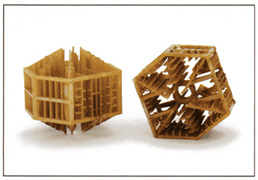
Willmar pilot column test specifications:
| Parameter | Value |
|---|---|
| Column diameter | 18 inches |
| Water flow | 20 gpm |
| Water temperature | 48°F |
| Air flow | 100 cfm |
| Packing height | 10 feet |
| Iron content — inlet | 1.96 ppm |
| Iron content — outlet | 0.04 ppm |