
The problem
The Suntory winery north of Tokyo faced a wastewater treatment capacity problem. Expanded grape pressing operations would raise the BOD of the plant's 0.53 MGD wastewater from 1,500 ppm to 3,000 ppm, overloading the existing aeration lagoons. Treatment options were limited: additional lagoons would consume precious space, generate twice as much sludge, and be equally vulnerable to shock loads. Anaerobic digesters would require close operator attention. Rotating biological contactors would be expensive to install and maintain. A trickling filter would require far too much space.
The CSCF BioReactor reduced BOD from 2,370 ppm to 11.8 ppm and destroyed BOD at 3.4× the rate of conventional activated sludge — in a fraction of the footprint.
Why NUPAC was selected
Suntory engineers opted to pilot test the continuously self-cleaning fixed-film (CSCF) BioReactor developed by the Able Co. of Japan, packed with No. 4 NUPAC supplied by Lantec Products.
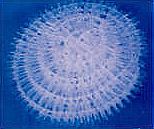
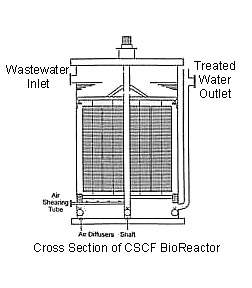
Wastewater entering the top of the reactor is aerated and mixed by an airlift system. NUPAC breaks the air stream into fine bubbles, resulting in oxygen transfer so efficiently that the system uses only about half the air of conventional fixed-film reactors. The packing has a specific surface area of 38 ft²/ft³, with uniform spacing of the polypropylene rods for easy dislodging of accumulated biofilm.
The packed section rotates slowly over an air-shearing device to control the thickness and age distribution of the attached biofilm and prevent anaerobic conditions from developing. Because the microbes remain in a high-growth phase and form a fully developed food chain in which larger organisms consume smaller ones, more BOD is converted to water and CO₂ and less to biomass — minimizing sludge production.
Meeting the requirements
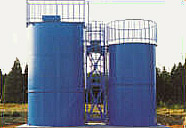
A pilot reactor 3 ft in diameter and 9 ft tall was installed at the winery. After a 3-week startup period, the unit reduced average BOD levels from 2,370 ppm to 326 ppm without clarification. When coagulant was added and suspended solids settled out, BOD fell to 11.8 ppm. The unit destroyed 137 lb of BOD per day per 1,000 ft³ of reactor volume, compared with 40 lb/day/1,000 ft³ for a typical activated sludge process.
The acclimated biofilm was highly resistant to shock from abrupt changes in BOD loading. Long-term loading variations could be compensated for by adjusting the frequency of air shearing.
Based on the pilot results, Suntory reviewed plans for a full-scale system of three reactors, each 25 ft in diameter and 20 ft high — which would destroy as much BOD as two 1,300,000-gallon aeration lagoons, in a fraction of the space. It has a simple design which allows it to operate with minimal operator attention or maintenance.
The CSCF BioReactor recently won the annual prize for innovative environmental treatment technologies awarded by Japan’s Ministry of International Trade and Industry.