
HD Q-PAC® Structured Media
Maximum removal per unit volume, sustained in the most challenging conditions
Oil-water separation, biotrickling H₂S control, and biological treatment all demand maximum surface area in continuous contact, under conditions that progressively blind or foul conventional media. HD Q-PAC is Lantec's highest-drip-point-density plastic packing, with self-cleaning rod geometry that sustains that surface availability where competing media fails.
How It Works
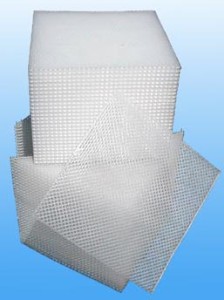
HD Q-PAC's structured 12" × 12" × 12" modules carry 75,000 drip points per cubic foot — the highest density in Lantec's plastic packing family. Each block stacks to any bed depth without shifting or compressing; all 132 ft²/ft³ of surface is exposed to the process fluid, with no internal pores or media-to-media contacts that blind it. Rounded rods at 90° to the flow direction, with 4mm minimum spacing, give suspended solids nowhere to bridge — particles shed through the open structure rather than accumulating. Conventional media fails precisely here: the narrow spacings that provide surface area also provide geometry for solids to build across. HD Q-PAC achieves tight spacing without that tradeoff.
That self-cleaning architecture enables distinct performance dynamics in each application below.
Oil-Water Separation
HD Q-PAC's tight rod spacing creates Reynolds numbers below 100 in normal separator service. At Re < 100, oil droplets rotate toward coalescing surfaces faster than Stokes' Law predicts: the velocity gradient near each rod surface spins droplets inward, accelerating coalescence beyond what surface area alone would produce.
Independent testing confirmed 99.98% oil removal at 12.7 gpm/ft² — exceeding the EN 858-1 test standard's own specified flux range, with no secondary polishing pad used or required. Field installations document the same self-cleaning geometry eliminating the maintenance cycles that define separator operation with conventional media. (Case History 38, Case History 45)
HD Q-PAC meets both API 421 and EN 858-1 standards for oil-water separator media.
Biotrickling Filters
Conventional biotrickling media fails H₂S service through the same mechanism in every form: surface area that becomes progressively unavailable. Lava rock pores blind at media-to-media contacts and are chemically attacked by the sulfuric acid byproduct. Peat and compost degrade under sustained acid exposure. Conventional plastic trickling filter media offers insufficient surface area, requiring residence times on the order of minutes and enormous footprints to compensate.
HD Q-PAC's rod geometry inverts this dynamic. Biofilm development on rounded surfaces increases effective surface area as the colony grows — from 132 ft²/ft³ dry to up to 300 ft²/ft³ under full biological load. Mature biofilm sloughs naturally before anaerobic dead zones form, maintaining aerobic conditions and keeping the bacterial colony in active growth phase throughout the bed. Polypropylene is unaffected by sulfuric acid. Independent testing confirmed equal H₂S destruction efficiency at three times the destruction density per cubic foot, one-twelfth the pressure drop, and one-third the required air residence time versus lava rock — with sustained 98–100% removal documented across multi-year municipal installations. (Case History 34, Case History 44)
Biological Treatment
The same biofilm growth dynamic that drives H₂S destruction performance applies across fixed-film biological treatment applications: groundwater bioremediation, aquaculture life support, and industrial biofilters. The requirement is identical — maximum accessible surface area for bacterial colonization, maintained under continuous biological loading.
In documented installations, HD Q-PAC has produced a 10,000-fold increase in active biological colony count versus unmediated treatment, with measurable improvements in dissolved oxygen, turbidity, and contaminant reduction across aquatic life support systems. The absence of harmful extractables found in PVC and CPVC media makes HD Q-PAC appropriate for sensitive aquaculture environments. (Case History 43, Case History 47)
Key Benefits
-
75,000 drip points per cubic foot — Highest density in Lantec's plastic packing family; all surface exposed to process fluid
-
Self-cleaning rod geometry — 4mm minimum spacing; solids shed through the open structure rather than bridging
-
API 421 and EN 858-1 compliant — Independently tested at 99.98% oil removal; no secondary polishing pad required
-
Sustained biological performance — Biofilm growth increases effective surface area to up to 300 ft²/ft³; self-regulating sloughing maintains aerobic culture
-
Structured modules — 12" × 12" × 12" blocks stack to any depth without shifting or compressing
Performance Data & Literature
Case Histories
- Trickling Biofilters for Hydrogen Sulfide Odor Control
- Zero Oil Discharge from HD Q-PAC OWS
- HD Q-PAC vs. Lava Rock in Biotrickling Filters
- Odor Complaints Eliminated at Municipal Lift Station
- HD Q-PAC Eliminates Plugging at Superfund Site OWS
- Significant Savings at Car Wash OWS
- HD Q-PAC in Aquarium Life Support
- Groundwater Bioremediation with HD Q-PAC
Technical Specifications
HD Q-PAC® Physical Properties
| Property | British Units | Metric Units |
|---|---|---|
| Material | Polypropylene | Polypropylene |
| Module Size | 12" × 12" × 12" | 305 mm × 305 mm × 305 mm |
| Specific Surface Area | 132 ft²/ft³ | 433 m²/m³ |
| Effective Biomass Surface Area | up to 300 ft²/ft³ | up to 984 m²/m³ |
| Drip Points | 75,000/ft³ | 2,650,000/m³ |
| Bulk Density | 7.5 lb/ft³ | 120 kg/m³ |
| Void Fraction | 87.8% | 87.8% |
| Smallest Grid Opening | 0.16" × 0.16" | 4 mm × 4 mm |
| Operating Flow Rates | 1–12 gpm/ft² | 40–490 L/min·m² |
| Temperature Limit | 200°F | 93°C |
Standards Compliance
- API 421 (Oil-Water Separator Design)
- EN 858-1 (Separator Systems for Light Liquids)