
Oil Water Separators
Coalescing media for industrial OWS applications, meeting API 421 and EN 858-1 standards without secondary polishing.
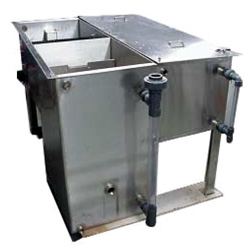
Oil water separators (OWS) remove emulsified and free oil from industrial effluent, stormwater, and process water before discharge or reuse. Coalescing media accelerates this process by providing surfaces where small oil droplets aggregate into larger droplets, increasing their buoyancy and rise velocity. The relationship is nonlinear: a 10x increase in droplet diameter produces a 100x increase in rise velocity (Stokes' Law). Coalescing efficiency therefore has an outsized impact on separator capacity and discharge quality.
Conventional coalescing media uses corrugated or inclined plates. The geometry forces a compromise: half the plate surface is oriented downward, the wrong direction to support droplet rise. Narrowing plate spacing increases surface area but reduces the already-limited void fraction, accelerating plugging from the sludge and solids that accompany the oil. This plugging failure mode is a recurring maintenance burden in standard OWS installations.
HD Q-PAC® addresses both limitations simultaneously with a fundamentally different geometry.
Coalescing Media for Oil-Water Separators
HD Q-PAC®
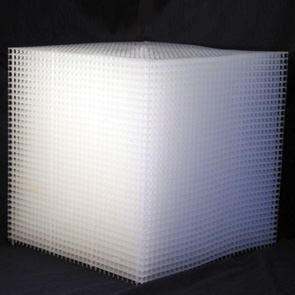
HD Q-PAC replaces corrugated plate media with structured modules of polypropylene needle-grid elements. All rod surfaces are oriented at 90° to the flow direction — the correct orientation for supporting oil droplet rise — and the open three-dimensional structure allows oil droplets to rise and solids to fall through the media without interference from one another.
The specific surface area of 132 ft²/ft³ (433 m²/m³) is entirely available for coalescence — not split between correctly and incorrectly oriented surfaces as in plate-type media. Field installations achieve non-detectable oil discharge under worst-case operating conditions including high inlet concentrations and peak flow events, without secondary polishing stages.
HD Q-PAC is made from oleophilic polypropylene, which actively attracts and retains oil droplets to accelerate coalescence. The material withstands operating temperatures up to 200°F (93°C) — significantly higher than PVC-based corrugated media, which begin to soften at 120°F (49°C). HD Q-PAC meets both API 421 and EN 858-1 standards for oil-water separator media.
Case Histories
HD Q-PAC coalescing media achieves zero discharge from high-concentration stormwater without secondary polishing
Corrugated coalescing media plugged every third day; HD Q-PAC resolves plugging without maintenance interruptions
HD Q-PAC retrofit pays for itself rapidly in reduced maintenance and disposal costs
Design principles and performance parameters for HD Q-PAC in oil-water separator applications
HD Q-PAC test results under EN 858-1 standard for separator systems for light liquids
Low Reynolds number physics of HD Q-PAC in oil-water separation — separation performance beyond Stokes Law predictions