
Biotrickling Filters
Structured packing media for biological odor control—no hazardous chemicals, sustained H₂S removal above 98%.
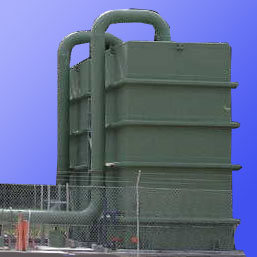
Biotrickling filters (BTFs) treat odorous air streams — primarily H₂S, ammonia, and VOCs from wastewater treatment facilities — by passing contaminated air through a bed of media colonized by microorganisms. The bacteria metabolize contaminants directly, converting them to harmless byproducts without generating chemical waste streams. This makes BTFs the cleanest available odor control technology: no caustic chemicals, no acid, no hazardous byproducts requiring disposal.
BTFs are particularly well-suited to air volumes up to approximately 12,000 cfm from a single tower. Higher volumes can be handled with multiple parallel units. The key performance variable is media selection: the packing must provide sufficient surface area for biofilm development, maintain aerobic conditions throughout the bed, and resist plugging as biofilm matures. Poorly-selected media limits treatment efficiency, fosters anaerobic zones that generate odor rather than removing it, and requires premature replacement.
Structured Media for Biotrickling Filters
HD Q-PAC®
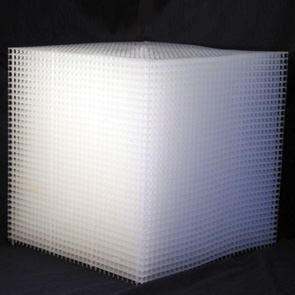
HD Q-PAC's structured needle-grid modules are the Lantec media of choice for biotrickling filter applications. The rod-based geometry provides 75,000 drip points per cubic foot — extensive surface area for biofilm attachment — while the open three-dimensional structure maintains airflow distribution and prevents channeling as biofilm grows. Effective biomass surface area reaches up to 300 ft²/ft³ (984 m²/m³) under mature biofilm conditions.
The rounded rod surfaces allow biofilm to slough naturally before anaerobic dead zones develop, maintaining aerobic conditions throughout the bed during continuous operation. This self-regulating behavior enables sustained H₂S removal above 98% over multi-year operating periods without bed replacement or significant intervention.
In direct comparisons with lava rock — a common BTF media alternative — HD Q-PAC has demonstrated both higher removal efficiency and lower maintenance requirements. The structured module format simplifies installation and media management compared to loose random packing in BTF applications.
Case Histories
Q-PAC acts as ideal biological growth media in lagoon aeration system, reducing BOD and eliminating odors
Winery cuts aeration system power by 65 hp using Q-PAC media in wastewater treatment
CSCF BioReactor with NUPAC reduces BOD from 2,370 ppm to 11.8 ppm; destroys 137 lb BOD/day/1,000 ft³
HD Q-PAC achieves 90–95% H₂S removal in under 10 seconds contact time at two municipal installations — no chemical scrubbers required
HD Q-PAC delivers triple the destruction efficiency and 90% lower pressure drop than ¾″ lava rock media
Zero H₂S odor complaints with minimal ongoing maintenance costs after HD Q-PAC installation
Fixed-film reactor with HD Q-PAC increases aerobic bacterial count 10,000-fold; hydrocarbons dramatically reduced